

A landing page built for paid traffic has one job: turn the click you already paid for into an action worth more than the click cost. Copy carries most of that weight. Design, layout, and page speed all matter, but the words decide whether a visitor understands the offer fast enough to act on it.
Most underperforming pages fail before anyone writes a headline. The research never happened, the offer was never sharpened, and the copy ends up describing a business instead of answering a visitor. The process below fixes that order of operations.
Research Comes Before the Headline
Creating a high-converting landing page starts before you write the headline or hunt for the perfect product photos and testimonials. That earlier work is where the copy is actually decided. If you skip it, you end up guessing at what your visitor cares about and then polishing guesses.
Speak Your Visitor's Language
Start by understanding the audience behind the traffic. Who clicked the ad, what did they expect to find, and what problem were they trying to solve at that exact moment? Landing page copywriting works best when it mirrors the words people already use when they describe their problem, not the polished language a company uses internally.
Collect that language from the sources you already have. Sales calls, support tickets, replies to your emails, and the questions prospects ask before they buy are all usable raw material. Write down the exact phrases people repeat. Those phrases belong in your headline, your subhead, and your objection handling, because recognition is what makes a visitor keep reading.
Define One Core Value Proposition
A landing page supports one offer and one action. The core value proposition is the single sentence that explains who the page is for, what they get, and why it beats the alternative. If you cannot state it in one line, the page will not be able to either, and the visitor will leave to compare options elsewhere.
Write that sentence down before you draft anything else. Every section you build afterward either supports it, proves it, or asks for the action it implies. Anything that does neither is a candidate for deletion.
Write a Hook That Stops the Scroll
The top of the page has to stop the scroll and confirm that the visitor landed in the right place. A strong headline solves the visitor's problem in plain terms and matches the promise made in the ad they clicked. Mismatch between ad and page is one of the fastest ways to lose a warm click.
Keep the hook focused on the outcome rather than the mechanism. Visitors rarely care how something works until they believe it will work for them. Lead with the result, the timeline, or the relief, then earn the right to explain the details further down the page.
The subhead beneath the headline carries the next job: clarify who the offer is for and remove the most obvious doubt. A headline without a clarifying subhead leaves visitors to interpret the promise themselves, and they usually interpret it pessimistically.
Structure the Page Around Working Sections
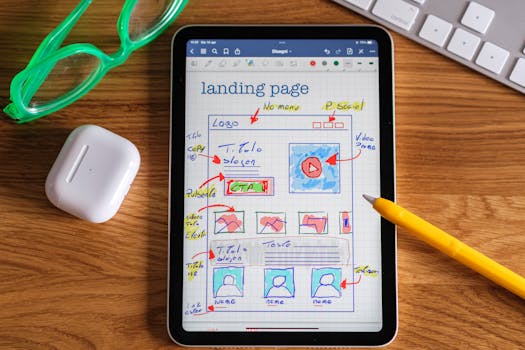
High-converting pages tend to follow a recognizable sequence. The sections are not a formula to copy word for word, but they map to the questions a visitor asks in order as they scroll.
| Section | What it must do | Common mistake |
|---|---|---|
| Hook and headline | Match the ad promise and name the outcome | Being clever instead of clear |
| Value proposition | Say who it is for and what they get | Listing features with no payoff |
| Proof | Show testimonials, results, or sample work | Making claims with nothing behind them |
| Offer detail | State exactly what happens after the click | Hiding the commitment or the next step |
| Call to action | Ask for one action with one clear verb | Offering five competing links |
Proof deserves more attention than it usually gets. Testimonials, before-and-after examples, and sample work answer the quiet question every visitor asks: has this worked for someone like me? If you publish any number, verify it against the original source before it goes on the page, and keep the context that made it true.
Remove Every Roadblock in the Visitor's Path
Conversion copywriting is as much about subtraction as addition. The job is to remove roadblocks and make the visitor's journey smooth, which means deleting anything that creates hesitation between the click and the action.
- Cut competing calls to action so there is one obvious next step.
- Move navigation, sidebars, and outbound links out of the way when they do not support the offer.
- Answer the top three objections directly instead of hoping the visitor forgets them.
- Replace vague form labels with language that explains what happens after submission.
- Keep button text specific to the outcome rather than a generic instruction.
Every extra choice costs attention. A page that asks for one thing tends to outperform a page that quietly asks for seven.
Techniques That Keep Readers Engaged
Landing page copy has to engage readers, not impress them. Engagement in this context means the visitor keeps scrolling and keeps agreeing, line after line, until the ask feels reasonable.
Lead Each Section With the Outcome
Open paragraphs and sections with what the reader gets. Details, specifications, and process explanations belong underneath the payoff, not in front of it. Readers scan, decide whether a section is worth their time, and only then commit to reading it fully.
Write Short Sentences and Shorter Paragraphs
Short sentences are easier to agree with. Long, clause-heavy sentences force the reader to hold too much in mind at once, and readers who lose the thread stop reading. Break ideas into small units and let each one land before the next begins.
Place Proof Wherever Doubt Appears
Doubt is local. It shows up right after a bold claim, next to the price, and beside the form. Put a testimonial, a sample, or a concrete detail at each of those points rather than saving all your proof for one section at the bottom that many visitors never reach.

Edit Like an Editor, Not an Author
First drafts explain. Second drafts persuade. Read your copy out loud and mark every sentence that does not answer a question, prove a claim, or move the reader toward the action. Then cut it. Most landing pages improve measurably from deletion alone.
Watch for hedged language during the edit pass. Words that soften a claim usually weaken it, and visitors read hesitation as a warning sign. Say what the offer does, who it is for, and what it costs in time, money, or commitment. Clarity is more persuasive than polish.
Test Copy in the Order It Appears
Once the page is live, change one element at a time and give each change enough traffic to say something meaningful. Headlines usually produce the largest swings because they decide whether anyone reads the rest. Subheads, proof placement, offer framing, and call to action text come next.
Write down what you changed and what happened. Without a record, teams cycle through the same variations and call it testing. If you need a benchmark, compare against your own previous result rather than an industry figure, since results depend heavily on the traffic source, the offer, and the quality of the click.

Where FastModernSites Fits In
Copy and page performance are linked. A persuasive headline on a page that loads slowly on a phone still loses visitors before they finish reading the first line. FastModernSites builds custom, mobile-first websites and paid-traffic landing pages with clean code and fast loading, which gives the copy a fair chance to do its job.
The studio works with a limited capacity model of 8 project slots per month, and pairs development with on-page and technical SEO plus ongoing maintenance and support. If your paid campaigns are sending clicks to a page that was never written for conversion, the copy and the build usually need fixing together.
Frequently Asked Questions
What is conversion landing page copywriting?
Conversion landing page copywriting is the practice of writing a page around a single action you want a visitor to take. Instead of describing everything a business does, the copy speaks to one audience, names one problem, and removes the friction between the click and the form. The goal is measurable action, not a literary impression.
How long should landing page copy be?
As long as it needs to remove doubt, and no longer. The copy should carry the visitor from the promise in the ad to a confident click. If a section does not answer a question, add proof, or move the reader toward the action, cut it. Long copy works when every line earns its place.
Is copywriting still worth the effort?
Yes. Paid traffic costs money on every single click, and weak copy wastes that spend continuously. The research, positioning, and structure behind strong copy are what separate a page that quietly leaks budget from one that returns more than it costs. Copy remains the cheapest lever you control.
What is a good conversion rate for a landing page?
There is no single number that applies to every business. A good conversion rate depends on the industry, the traffic source, the offer, and the quality of the click. The practical benchmark is your own baseline. Track your current rate, change one element at a time, and compare against your previous result.
Should I use a copywriting template?
Templates are a useful starting point because they show a proven order for the sections. They are a poor finishing point. A template cannot know your visitor's objections, your proof, or the language your best customers use. Use the structure, then rewrite every line with real research behind it.